
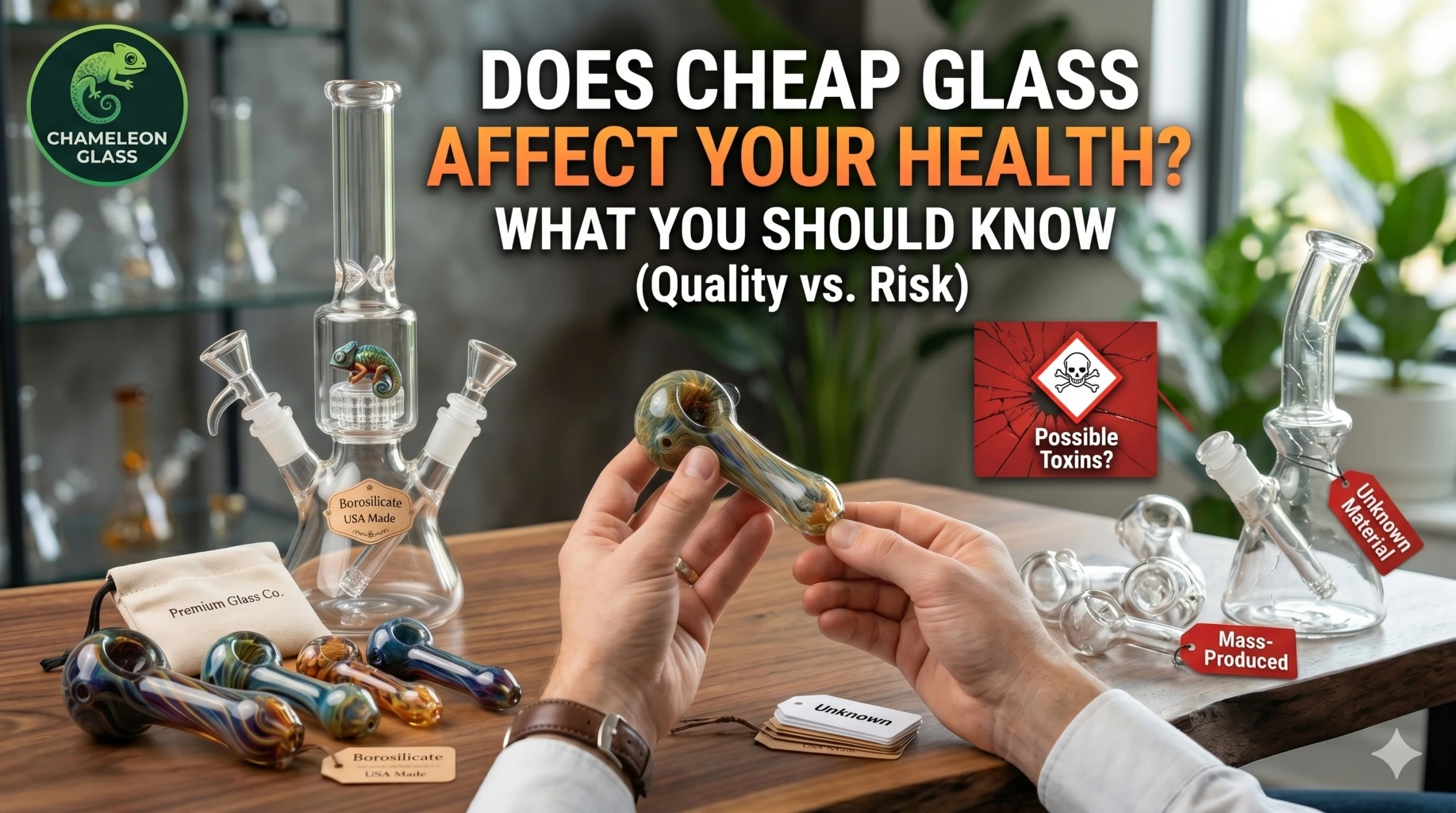
Does Cheap Glass Affect Your Health? What You Should Know
Most people who buy a cheap glass pipe are thinking about price, not health. That’s understandable. At face value, glass looks like glass — inert, neutral, harmless. But what’s actually inside that $10 import from an overseas supplier is a question worth taking seriously before you light up.
The short answer is this: not all glass pipes carry the same health risks, and the risks associated with cheap imported pipes are not theoretical. They are documented, specific, and directly tied to the manufacturing shortcuts taken when producing glass at the lowest possible price. Understanding them doesn’t require a chemistry degree — it just requires knowing what to ask and what to look for.
This is everything you should know about what cheap glass pipes can expose you to, how those risks arise, and what a properly made, American-built pipe does differently.
The Import Loop: Why Most Cheap Pipes Come In Without Bowl Holes
Before getting into materials, it’s worth understanding how cheap imported pipes get into the country in the first place — because the process itself creates the first and most immediate health hazard.
Under US federal law, glass pipe imports are subject to import tariffs as smoking accessories. To sidestep these costs, overseas manufacturers ship their pieces without bowl holes — which technically classifies the piece as a glass pendant or jewelry, not a pipe. Once the “jewelry” clears customs, importers drill the bowl holes domestically.
As Chameleon Glass documents on their Why Chameleon page and Made in USA vs. Import blog: that drilling process leaves glass dust and particles inside the pipe. Most importers do not clean the pipe after drilling because cleaning costs money, and in a race to the bottom on price, your health is not a budget line item.
The result is a pipe that ships to a store or a customer with fine glass particles sitting loose inside the bowl, the neck, and the mouthpiece — ready to be inhaled directly on the first hit.
That is not a small problem. As Chameleon Glass states directly on their Glass Education page: glass dust is 100 times more dangerous than asbestos. The comparison is to silicosis — a serious, progressive, and incurable lung disease caused by inhaling fine silica particles. Glass, at its core, is a silicate compound. Fine glass dust and glass fiber particles behave in the lungs the same way asbestos fibers do: they embed in lung tissue, cause scarring, restrict function, and cannot be expelled by the body.
At Chameleon Glass, every single bowl hole is blown during the pipe’s creation — never drilled afterward. The bowl hole is formed while the glass is molten, leaving smooth edges and no residue. Every bowl is then QC’d with a precision tool to verify the opening falls between 2mm and 3mm — the functional sweet spot for clean airflow. No drilling. No glass dust. No residue left behind.
Before buying any imported pipe — whether from a local shop or a website — tap the mouthpiece against a hard surface and look at what falls out. If you see any fine dusty residue, that’s glass. Not shipping debris. Ground glass dust from the post-import drilling process, left for you to inhale on the first session.
Soda-Lime Glass: The Material Question
The drilling hazard is the most immediate risk. The material risk is slower and more insidious.
Quality glass pipes are made from borosilicate glass — an engineered material containing silicon dioxide and boron oxide that is chemically stable, thermally resistant, and genuinely inert under normal use. It doesn’t leach compounds into your smoke. It handles repeated heat cycles without degrading. It is the same material used in laboratory glassware, high-end cookware, and medical equipment — applications where chemical neutrality is non-negotiable.
Every Chameleon Glass pipe — from the entry-level Pinch Taster Chillum to the Smokestack Spoon, the Vandal Glass Pipe, and the full Water Pipe and Bong collection — is made from genuine borosilicate. The material is specified in every product description because it matters enough to say plainly.
Cheap imported pipes are typically made from soda-lime silicate glass — the same material used in bottles, jars, and packaging. Standard soda-lime glass from a reputable manufacturer used as food-contact material is generally considered safe in normal use. The problem for pipe smokers is the environment the glass operates in.
Soda-lime glass has a significantly higher thermal expansion coefficient than borosilicate — meaning it expands and contracts more dramatically when heated and cooled. In a pipe, this happens with every single session. The bowl is exposed to direct flame, then cools. The neck heats from passing smoke, then cools. Repeated thermal cycling in an unannealed soda-lime glass pipe creates micro-fractures over time. Those micro-fractures don’t just weaken the pipe structurally — they create pathways for fine glass particles to enter the airstream during use.
Beyond thermal behavior, the composition of cheap imported colored glass is a legitimate concern. Adding color to glass requires additives — and while reputable manufacturers use food-safe inorganic mineral pigments, unregulated overseas production may use colorants containing heavy metals including cadmium, arsenic, or lead compounds. Once the pipe is exposed to repeated high-temperature cycling, the stability of those colorant additives can degrade. You’re inhaling smoke that has passed through a bowl and neck made of material whose composition you cannot verify and whose production you cannot trace.
The Pyrex Ain’t Pyrex Anymore blog post from Chameleon Glass documents this material substitution problem directly: true borosilicate glass, when submerged in vegetable oil, virtually disappears because the two materials share the same refractive index. A competing imported brand’s bong, when tested the same way, did not disappear — confirming it was soda-lime, not borosilicate. You cannot tell the difference by looking at or handling the pipe. The only way to know what you’re smoking through is to know where the pipe was made and by whom.
Unannealed Glass: The Hidden Structural Risk
The third health-adjacent risk of cheap glass pipes is less direct but worth understanding: unannealed glass degrades into sharper, more unpredictable failure modes.
When a properly annealed glass pipe breaks — and even quality pipes break if dropped from height — the breakage tends to follow the shaped structure of the piece. When an unannealed pipe with high residual stress fails, the internal stress fractures release suddenly and explosively. The piece can shatter rather than crack, releasing sharp glass fragments into the surrounding environment — or worse, directly toward the user.
As Chameleon Glass explains in The Story Behind Your Hand Pipes, annealing eliminates internal stress by holding finished glass at precisely controlled temperatures in a kiln, allowing the molecular matrix to reform after the stress of blowing and shaping. Imported manufacturers skip this step because proper kiln annealing requires expensive kilns, significant electricity, and time — costs that evaporate their margins.
The risk is greatest at the bowl, where heat concentration during every session creates ongoing thermal stress — and where post-import drilling has already imparted additional mechanical stress at the precise point of maximum heat exposure.
Every Chameleon Glass pipe — whether a compact Ash Catcher Chillum, a detailed Dragon Head Glass Pipe, or a full Cambio Series Water Pipe — is kiln-annealed at 1,050°F using a precise step-down process, then inspected under a polariscope before it leaves the facility. No imported bargain pipe at any price point can honestly make that claim.
What a Health-Conscious Pipe Setup Actually Looks Like
Beyond the materials and manufacturing question, specific design choices in pipe engineering directly affect what you inhale during normal use — and this is where Chameleon Glass’s innovation history becomes directly relevant to the health conversation.
Ash and particulate filtration is the most impactful design feature for cleaner inhalation from a hand pipe. Chameleon Glass invented the ash catcher mouthpiece in 2002 — an indented mouthpiece design that uses gravity to pull ash and solid particulate down into the indent rather than forward into your lungs. This is not an add-on or an accessory. It’s built directly into the pipe.
The ash catcher mouthpiece is available across the full Chameleon hand pipe range:
- Ash Catcher Glass Pipe — the original 2002 design in clear glass
- Ash Catcher Chillum Glass Pipe — compact chillum format with color-change fuming
- Ash Catcher Steamroller Glass Pipe — straight tube for bigger hits, no ash in your mouth
- Ash Catcher Slugger Glass Pipe — portable baseball bat-shaped option
- Ash Catcher Lawnchair Sherlock Glass Pipe — Sherlock-style with built-in legs to stand upright
- Ash Catcher with Pattern Glass Pipe — silver fuming, color-change, full ash filtration
- Aragorn’s Ash Catcher Glass Pipe — LOTR-inspired, travel-ready, color-changing
Every one of these is a passive, maintenance-free filtration system that works on every hit without any additional setup.
Cyclonic pre-filtration takes the clean-hit concept further for dry pipe users. The Typhoon Classic Centrifugal Filter Glass Pipe uses specially engineered air directors on each side of the pipe that create a vortex inside the chamber. As the smoke spins through the cyclonic path, centrifugal force deposits combusted tar and ash against the glass walls — keeping them from entering your lungs. The smoke and air mixture travels three times further through the looping circular path compared to a traditional straight pipe, giving it significantly more time to cool before inhalation.
Variations of the Typhoon design include:
- Typhoon Cyclonic Pre Filter — inline attachment that purifies smoke before it enters your water pipe
- Bonehead Typhoon Glass Pipe — the Typhoon Classic with skull sculpting for collectors who want function and personality in one piece
Water filtration remains the most effective passive filtration method available in any hand pipe format. Passing smoke through water cools it and removes a meaningful portion of particulate before it reaches your mouthpiece. The Monsoon Spill-Proof Glass Bubbler was originally designed in 2003 for a touring musician with severe asthma who needed portable water filtration without the bulk or spill risk of a traditional bong. Its gravity-and-surface-tension percolator system passes every draw through water, and the spill-proof design means you’re not managing water loss every time you move it.
For those who want water filtration in different formats, Chameleon Glass offers a full range:
- Monsoon Vibe Spill-Proof Glass Bubbler — the classic Monsoon functionality in vibrant pastel borosilicate colors
- Cyclops Monsoon Spill-Proof Bubbler — compact, fun design with full water filtration
- Easy Clean Glass Bubbler Water Pipe — modular design with an extra-large 45/50mm joint for effortless cleaning access
- Cambio Series Glass Water Pipe — compact 9″ borosilicate bong, double-annealed, made in the USA
- My RX Glass Water Pipe — 38mm diameter, 4mm wall thickness borosilicate, double-annealed, with ice pinch for additional cooling
For a full selection of water pipes, bubblers, and bongs, browse the Water Pipe and Bong collection and the Bubbler collection.
The Pipe You Clean Is Safer Than the One You Don’t
One more health consideration that applies regardless of pipe quality: a dirty pipe is a less healthy pipe.
Resin buildup inside the bowl and neck concentrates combustion byproducts that get re-volatilised with every subsequent session. A clean glass pipe produces a fresher, cooler, and less contaminated draw than a heavily clogged one. The non-porous nature of glass makes it uniquely suited to full cleaning — unlike wood or metal pipes that absorb residue permanently into the material, a glass pipe cleaned properly can be restored to near-original condition.
For hand pipes, the Chameleon Glass Cleaning Kit bundles the Original Buddy Scrubber, a 14mm or 19mm Cleaning Plug, and USA-made KLEEN solution into one complete package. For a standalone soak-and-rinse cleaner that requires no scrubbing — ideal for intricate or multi-chambered pieces — the Kleen Soaker is the go-to choice. Non-toxic, alcohol-free, reusable, and made in the USA.
For water pipes and bongs, the Cleaning Plug for Glass Water Pipe seals the joint opening during cleaning so solution doesn’t spill during soaking — a simple tool that makes the process dramatically less messy.
One important note specific to color-changing pipes: never use a cleaner with more than 50% alcohol content on an internally fumed piece. Strong solvents can strip the internal fume layer permanently, ending the color-change effect. Kleen Soaker is safe on all types, including fumed glass. For full guidance on cleaning methods by pipe type, read the Glass Education page and the Cleaning Your Glass Pipe Super Quick blog.
The Bottom Line
Cheap glass pipes are not just an aesthetic or durability problem. They represent a specific set of health risks that most buyers are never told about: glass dust left behind from post-import drilling, unverified material composition in cheap soda-lime glass, and unpredictable shattering from residual stress in unannealed pieces.
None of these risks exist in a properly made, American-built borosilicate pipe with blown bowl holes, kiln-annealed to eliminate residual stress, and inspected before it ships. The price difference between that pipe and a cheap import is not a luxury premium. It’s the cost of not inhaling ground glass on your first hit.
Browse the full Glass Pipes collection — from hand pipes and chillums to bubblers, Monsoons, and full water pipes — and read the Glass Education page for a complete picture of what separates quality glass from everything else on the market.

Leave a Reply
You must be logged in to post a comment.