
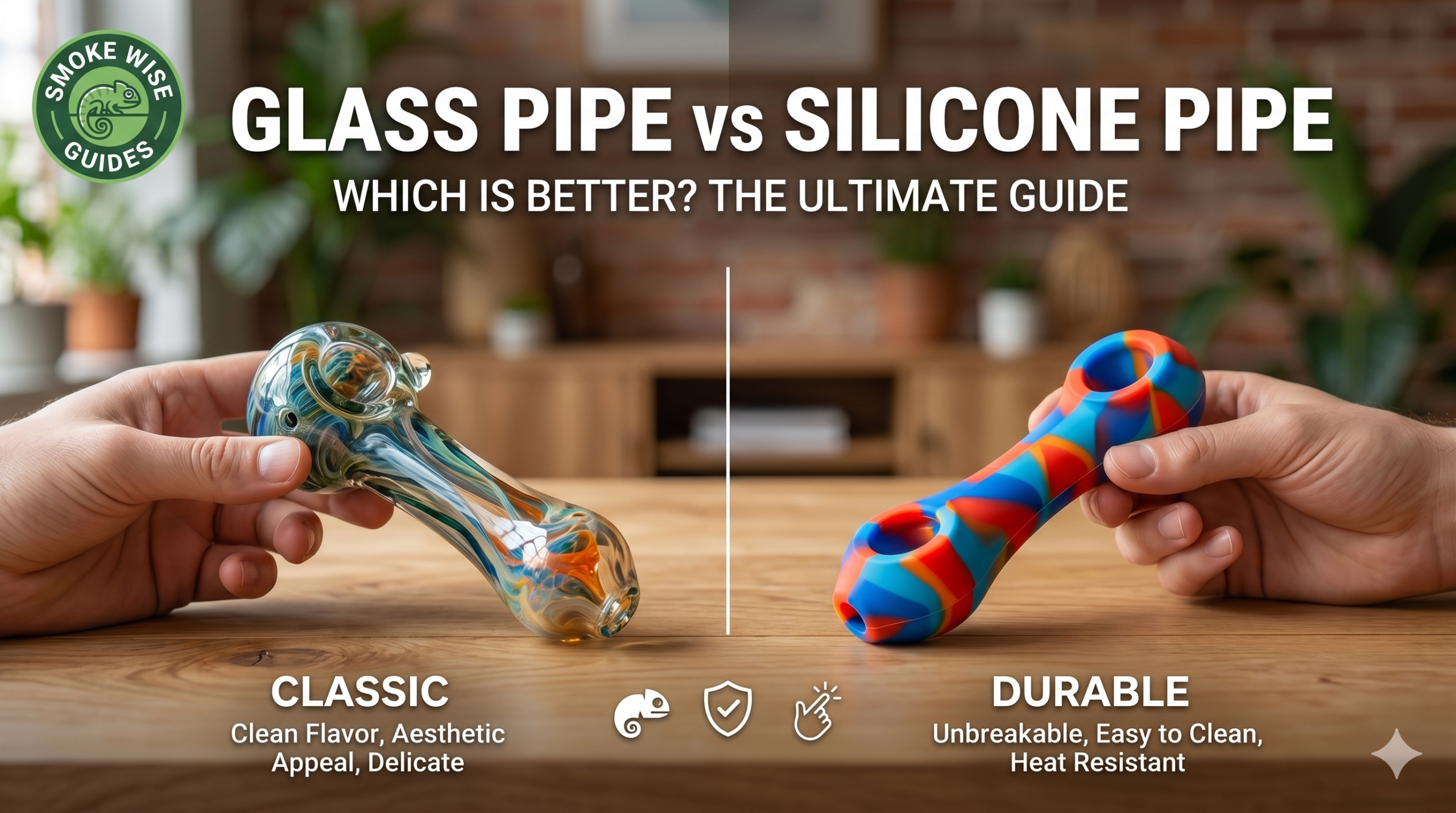
Glass Pipe vs Silicone Pipe: Which Is Better?
Silicone pipes have carved out a real place in the market over the past decade. They’re cheap, nearly unbreakable, and easy to find. For a lot of new smokers, a silicone pipe is the first thing they buy — it’s practical, no-nonsense, and nothing to worry about if it gets knocked around.
But here’s the question that serious smokers eventually ask: is a silicone pipe actually good, or is it just hard to break?
The answer is more nuanced than either side of the debate usually admits. Silicone has genuine advantages in specific situations. Glass wins across almost every other dimension that matters to a smoker who cares about their experience. The right choice depends entirely on how you smoke, where you smoke, and what you value in a session.
This guide breaks it down category by category — flavor, durability, heat, cleaning, health, aesthetics, and value — so you can make an informed decision rather than defaulting to whichever material was cheapest at the time of purchase.
Flavor: The Category Where Glass Wins Completely
This is the most important comparison for any smoker who gives a damn about what their tobacco actually tastes like — and it isn’t close.
Borosilicate glass is chemically inert. It doesn’t react with heat, doesn’t absorb compounds from smoke, and doesn’t release anything into your airstream. What goes into the bowl is exactly what reaches your mouth — no interference, no added flavors, no material aftertaste. A clean glass pipe delivers a completely neutral, pure smoking experience every single time.
Silicone is a different story. Food-grade silicone is considered safe for use at high temperatures — up to around 230°C — and it’s widely used in cookware, baking molds, and medical equipment for good reason. But “safe” and “flavorless” are not the same thing. Silicone is a synthetic polymer, and even high-quality versions of it can impart a faint rubbery or muted undertone to smoke, particularly when the pipe is new or hasn’t been broken in with extensive use. Many users report this taste diminishing over time — but never disappearing entirely.
For tobacco smokers who appreciate the actual flavor of what they’re smoking, this matters. A glass pipe doesn’t mute your experience. It delivers it intact. The Vandal Glass Pipe, the Waterfall Spoon Glass Pipe, the Smokestack Glass Pipe — every one of these delivers a clean, unaltered draw that silicone simply cannot replicate.
Winner: Glass — and it’s not even debatable.
Durability: The One Category Where Silicone Has a Genuine Edge
Silicone pipes are effectively unbreakable under normal use. You can drop them on concrete, sit on them, throw them in a bag with your keys and phone, and they’ll come out fine. For outdoor use, festival environments, travel, or anywhere that a glass pipe would be at real risk of breaking, silicone’s durability advantage is legitimate and worth acknowledging.
Glass pipes, by contrast, can break if dropped — especially cheap, unannealed imports. This is where the quality of the glass matters enormously. A properly made, kiln-annealed borosilicate pipe is significantly more resistant to impact than unannealed glass, and far more thermally stable than either silicone or cheap soda-lime glass. It won’t flex the way silicone does, but it won’t develop the micro-fractures under heat cycling that cheap glass develops either.
As Chameleon Glass documents in The Story Behind Your Hand Pipes, every piece is annealed at 1,050°F using a controlled step-down kiln process that eliminates residual internal stress — the primary cause of unexpected breakage in glass pipes. The Ash Catcher Lawnchair Sherlock Glass Pipe, for example, has customer reviews describing the pipe bouncing on concrete and surviving intact, ringing like a chime. That’s what proper annealing produces.
The honest summary: silicone is more drop-resistant by virtue of its material flexibility. But a quality annealed borosilicate pipe is far more durable than any cheap import and far more thermally stable than any silicone piece. If you’re choosing between a silicone pipe and a cheap Chinese glass pipe, silicone wins on durability. If you’re choosing between silicone and quality American-made borosilicate, the gap narrows considerably.
Winner: Silicone for portability and drop resistance. Quality glass closes the gap significantly for everything else.
Heat Resistance: Glass, and It’s Not Close
This is a material science question with a clear answer. Borosilicate glass is specifically engineered for high-temperature applications. It has a low thermal expansion coefficient — it doesn’t expand and contract dramatically under heat cycling, which is what makes it durable through repeated lighting and cooling. The bowls on Chameleon Glass hand pipes handle direct flame without any degradation to the material.
Silicone’s upper heat limit is typically around 220-230°C for food-grade versions. That sounds like a lot until you realize that a butane lighter flame burns at roughly 1,430°C and that the glass bowl directly in contact with that flame is experiencing temperatures far above silicone’s tolerances. Most silicone pipes compensate by including a glass bowl insert — meaning the part of the pipe that actually matters most for heat resistance is glass anyway.
Silicone that is repeatedly exposed to heat above its design threshold starts to degrade. That degradation releases volatile compounds into the air — which, in a pipe you’re smoking from, means into your lungs. High-quality, thick-walled borosilicate glass doesn’t have this problem. It handles the same heat cycle every session without any molecular change.
Winner: Glass.
Cleaning: Closer Than You’d Expect
Silicone pipes have a practical cleaning advantage in one specific way: you can boil them. Submerging a silicone pipe in boiling water for a few minutes will loosen and remove most resin buildup efficiently. Some silicone pipes are also dishwasher-safe, which makes routine maintenance genuinely low-effort.
Glass pipes are non-porous, which means residue sits entirely on the surface and can be fully removed with the right cleaner. The Kleen Soaker from Chameleon Glass requires nothing more than a soak and a rinse — no scrubbing, no boiling, no agitation. For water pipes, the Cleaning Plug for Glass Water Pipe and the Original Buddy Scrubber (included in the Chameleon Glass Cleaning Kit) make the process straightforward and spill-free.
The meaningful difference is what clean actually means. A cleaned silicone pipe may be residue-free, but silicone’s slight porosity means absorbed odors and trace compounds remain in the material over the long term. A cleaned glass pipe is restored to chemical neutrality — the next session is genuinely fresh, not just physically clean.
For color-changing glass pipes — including the Ash Catcher with Pattern Glass Pipe or the Neutrino Dichro Sherlock — avoid cleaners with more than 50% alcohol content, as strong solvents can affect the internal fume layer. Kleen Soaker is alcohol-free and fully safe for fumed glass.
Winner: Slight edge to silicone for convenience. Glass wins on what “clean” actually means.
Health Considerations: Both Can Be Fine — But Context Matters
High-quality, food-grade, BPA-free silicone is considered safe for use in the context it was designed for. The concern arises when silicone quality isn’t verified, when repeated heat exposure exceeds the material’s rated limits, or when the glass bowl insert is removed and the silicone body is exposed to direct heat. Cheap silicone products may contain fillers or plasticizers that degrade differently than pure food-grade silicone — and in a market where product sourcing is opaque, “food-grade silicone” on a label doesn’t always mean what it implies.
Borosilicate glass, when properly made, is one of the most chemically inert materials used in consumer products. The risks associated with glass pipes come not from the material itself but from manufacturing shortcuts — specifically, the practice of drilling bowl holes post-import and leaving glass dust inside the pipe. As Chameleon Glass documents on their Glass Education page, glass dust is considered 100 times more dangerous than asbestos, and the silicosis risk from inhaling fine silica particles is real and documented. This risk exists specifically with cheap drilled imports — not with American-made pipes where bowl holes are blown rather than drilled.
For a detailed breakdown of these specific risks, read the Why Chameleon page and the Made in USA vs. Import blog.
Winner: Quality glass from a verified manufacturer. The risk with silicone is quality-dependent; the risk with glass is manufacturing-method-dependent. Know your source.
Aesthetics and Craftsmanship: No Contest
A silicone pipe is a tool. It’s functional, colorful in a basic way, and entirely replaceable. There is no such thing as a silicone pipe you’re proud to own, display, or show someone for the first time.
A quality glass pipe is a different category of object entirely. The inside-out double-blown technique used by Chameleon Glass produces decoration that is fully encased within the glass wall — not surface-applied, not painted on, but structurally part of the pipe itself. The fuming process creates color change that evolves uniquely with every pipe based on use patterns. No two fumed pipes look identical after a few weeks of ownership.
Consider what silicone could never produce: the Spyrogyra Dichro Glass Pipe with multilayered silver and gold fuming applied inside-out. The Neutrino Dichro Sherlock with cobalt blue-backed dichroic strips floating within the glass wall. The Oxford Glass Pipe with full-piece gold and silver fuming spanning mouthpiece to bowl, developing a color shift that becomes more beautiful with every session.
These aren’t mass-produced items. They’re made by experienced artisans who have been blowing glass in the USA since 1991. No polymer manufacturing process produces functional art. Glass does.
Winner: Glass, by an unbridgeable margin.
Value: Which Material Actually Lasts Longer?
Silicone pipes are cheap to buy. That’s genuinely true. A silicone spoon can be had for well under $20, and it won’t break.
But value is not the same as price. A properly made borosilicate glass pipe, cared for correctly, lasts for years or decades. It doesn’t degrade thermally the way silicone does. It doesn’t retain odors that affect every future session. It can be cleaned to full neutrality. And critically, it doesn’t need to be replaced on any timeline other than accidental breakage.
The Smokestack Glass Pipe and Smokestack Onie are a matched set that together represent one of the most durable and practical everyday glass smoking setups available — compact, annealed borosilicate, handmade in the USA, and designed to last. The Waterfall Chillum and Waterfall Standup Sherlock offer the same durability in a visually distinctive package. For water pipe users, the Monsoon Spill-Proof Bubbler has been in continuous production since 2005 because it simply works — and one purchase is all most smokers ever need to make.
A cheap silicone pipe bought three times over five years costs more than one quality American-made glass pipe that lasts the same period — with a fundamentally better smoking experience throughout.
Winner: Quality glass, when viewed over any meaningful time horizon.
The Verdict
| Category | Glass | Silicone |
|---|---|---|
| Flavor purity | ✅ Wins clearly | ❌ Rubbery undertones possible |
| Drop resistance | ❌ Can break if dropped | ✅ Virtually unbreakable |
| Heat resistance | ✅ Wins clearly | ❌ Rated limits exist |
| Cleaning | ✅ Fully restorable | Convenient but retains odors |
| Health (verified) | ✅ Inert, no degradation | Quality-dependent |
| Aesthetics | ✅ No comparison | ❌ Functional only |
| Long-term value | ✅ Lasts decades | Degrades over time |
Silicone earns its place as a travel pipe or outdoor backup — for situations where dropping a glass pipe is a genuine risk and flavor is a lower priority than survival. In every other context, glass wins on flavor, purity, craftsmanship, aesthetics, and long-term value.
If you’ve been smoking from a silicone pipe and wondering why your sessions feel a bit muted or flat — now you know why. Browse the full Glass Pipes collection and read the Glass Education page to understand exactly what a quality American-made borosilicate pipe delivers that no other material can match.

Leave a Reply
You must be logged in to post a comment.