
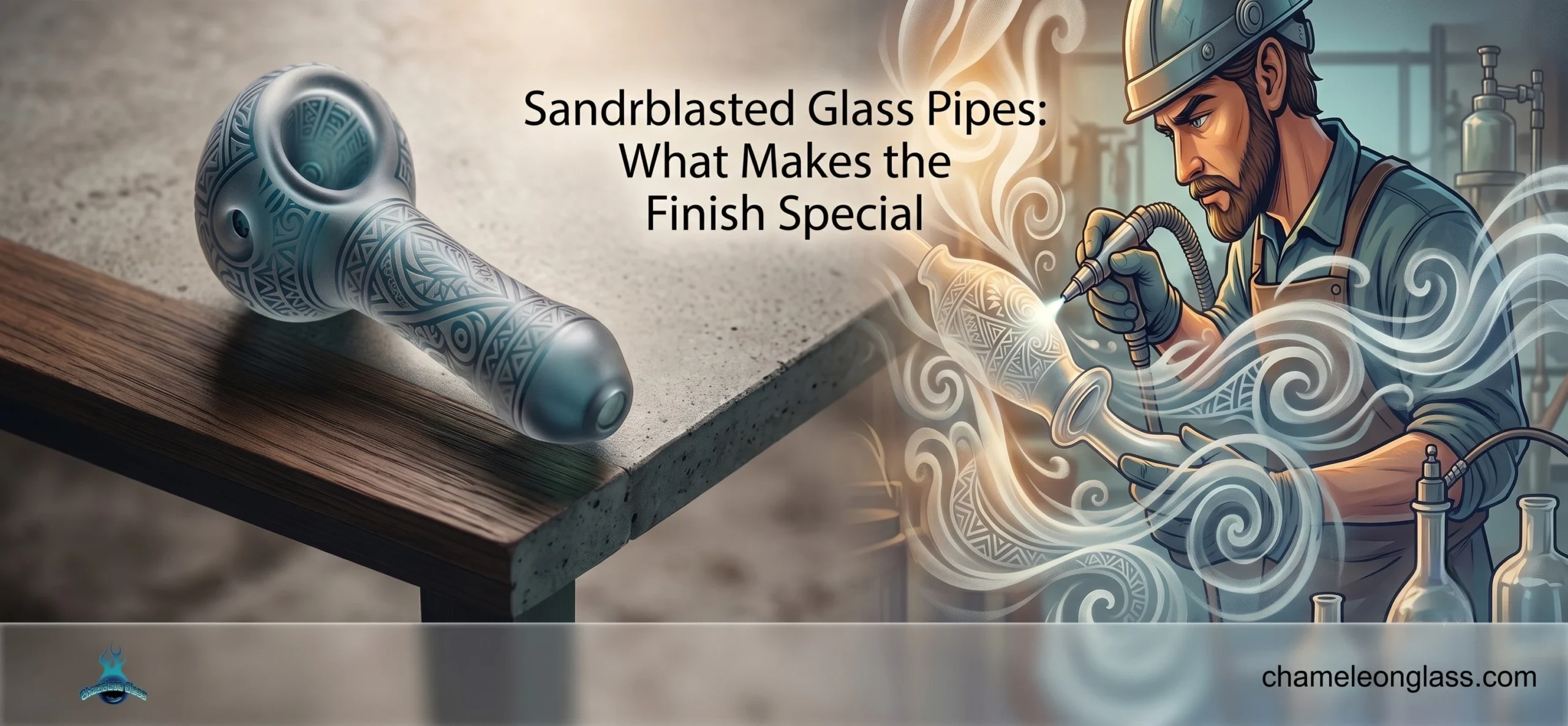
Sandblasted Glass Pipes: What Makes the Finish Special
Sandblasted Glass Pipes: What Makes the Finish Special
Most glass pipes are polished smooth. That glassy, transparent surface is the default — and for good reason. It’s clean, it photographs well, and it shows off the color work inside. But there’s a whole category of glass pipe finishing that works completely differently: sandblasting.
Sandblasted pipes feel different the moment you pick one up. The surface is matte and tactile rather than slick and smooth. The color presentation shifts. The way light interacts with the glass changes entirely. And getting that finish right requires a post-production process that most pipe manufacturers don’t bother with.
Here’s what sandblasting actually does to glass, why it changes the smoking experience, and which Chameleon Glass sandblasted pieces are worth knowing.
What Sandblasting Does to Glass — And Why It Matters
Sandblasting — more precisely called media blasting in professional glasswork — is a surface treatment applied to a finished, annealed glass pipe. The pipe is placed in a cabinet and subjected to a high-pressure stream of abrasive particles (usually aluminum oxide or silica carbide) that microscopically roughen the glass surface. The result is a uniform, frosted texture across the exterior.
This is not a shortcut. It’s an additional step that happens after the pipe has been blown, decorated, and kiln-annealed. As Chameleon Glass documents on the Pandemonium Sandblast Glass Pipe product page: “After annealing, the Pandemonium Sandblast Glass Pipe is finished in a frosty sandblasted texture.”
The sequence matters. Annealing first, sandblasting second — because the annealing process requires the glass surface to be intact for the kiln to work correctly. A manufacturer that cuts corners skips annealing entirely, which means their sandblasted pipe has the matte aesthetic but none of the structural benefits of proper kiln treatment.
How Sandblasting Changes What You See and Feel
Tactile grip: Smooth glass can be slippery — particularly when warm from a session. The microscopically roughened surface of a sandblasted pipe gives your fingers genuine purchase. This is especially meaningful for compact pipes that are held and passed frequently.
Matte color depth: Here’s the counterintuitive part — a frosted surface often makes color work appear richer and more complex than a polished surface. Because light scatters across the matte texture rather than passing through cleanly, it reveals depth in layered fume and color work that polished glass can suppress. The variegated, polychromatic finishes on Chameleon Glass sandblasted pieces look more dimensional in person than in photos for exactly this reason.
Fume encapsulation: On the Pandemonium design specifically, marbles encapsulate sections of silver and gold fume before sandblasting — protecting the fume layer from the abrasive media while allowing the surrounding glass to receive the matte finish. The result is a tactile contrast between the glossy marble surfaces and the frosted glass body that’s as functional as it is visual.
The Chameleon Glass Sandblasted Collection
Amazeballs Sandblast Glass Pipe — The foundational sandblasted spoon in the lineup. Features double Maria’s on the neck (decorative glass rings applied by heating and pinching), a gold fume trap on the head, and a striped variegated polychromatic striking finish — then media blasted to a matte texture. Available in Grape Purple, Double Amber, Blue Moon, and Green Amber. Each one develops slightly differently because the color work is individually applied. Handcrafted in the USA.
Pandemonium Sandblast Glass Pipe — The most technically intensive sandblasted pipe in the catalog. A full-length cobalt tube fumed entirely in silver, with sections receiving additional gold fume over the silver. Each of the 40+ marbles is painstakingly placed and fabricated in position — encapsulating the fume to protect it during shaping while the pipe is formed around them. “Secure your safety belts,” the product description reads, “the Pandemonium Sandblast Glass Pipe is a bumpy ride.” The knobby, variegated surface means no two pieces look identical. Handcrafted in the USA.
Plasmatic Sandblasted Glass Pipe — Gold and silver fume overlays on colored base tubing, with clear marbles, stripes, and dots of glass that create a prismatic effect as light passes through. “As light passes through the layers of fume and clear decoration,” the product description notes, “it undergoes a transformative prismatic effect, resulting in a mesmerizing display of unique colors in every piece.” Handcrafted in the USA.
Browse the full Sandblasted collection for all available styles.
Sandblasted vs. Polished: Which Should You Choose?
- Choose sandblasted if grip matters to you, if you prefer a matte aesthetic, if you want color work that looks dimensional and rich, or if you’re adding to a collection and want visual variety beyond standard polished glass.
- Choose polished if transparency is the point — particularly for color-changing fumed pipes where watching the color develop through clear glass is part of the appeal.
Neither finish affects airflow, annealing quality, or how the pipe smokes. Sandblasting is a surface treatment only — the underlying borosilicate and kiln-annealing are identical.
Cleaning Sandblasted Glass: One Important Note
The matte texture of a sandblasted pipe means residue from handling — skin oils, fingerprints — shows differently than on polished glass. For cleaning the interior, the Kleen Soaker soak method works exactly the same as on any glass pipe. For the exterior, avoid abrasive scrubbing that could uneven the sandblasted texture further — a soft cloth and warm water handles fingerprints cleanly.
For full cleaning guidance by pipe type, visit the Glass Education page.
FAQ: Sandblasted Glass Pipes
Does sandblasting weaken the glass? No — media blasting affects only the microscopic surface layer of the glass, not the structural wall thickness or the borosilicate matrix. The annealing process, which determines structural strength, happens before sandblasting.
Will the sandblasted texture wear smooth over time? With heavy daily handling, very gradual smoothing of the highest surface points is possible over years — but the texture is durable and does not “wear off” in any meaningful timeframe under normal use.
Can sandblasted pipes be cleaned the same way as polished glass? Yes for the interior. The Kleen Soaker and warm water rinse method is safe and effective. Avoid abrasive cleaning pads on the exterior surface.
Are sandblasted pipes more expensive? The additional post-production step does add cost, which is why most budget imports skip it entirely. Quality sandblasted pieces like the Pandemonium reflect both the complexity of the decoration underneath and the finishing step on top.
The skull is one of the most enduring symbols in human culture — mortality, defiance, transformation, and dark humor all compressed into a single icon. It appears in art from ancient Mesoamerica to modern streetwear, in religious iconography and rock music, in Día de los Muertos altars and pirate flags. It is simultaneously the most universal and most personal symbol a person can carry.
Chameleon Glass has understood this from the beginning. The Bonehead — their flagship skull pipe — isn’t just a product. It’s a character with a philosophy, a family of variants, and a collector community that has been buying and discussing these pieces for years. This guide covers the full skull collection, the ideas behind each piece, and what makes them worth owning beyond the aesthetic.
The Bonehead Origin: A Daily Reminder
The Bone Head Skull Glass Pipe was built around a specific idea, articulated directly in Chameleon Glass’s own product copy: it is a “daily reminder of our own mortality so that we may live the lives we are blessed to lead to the fullest, so when we reflect on all that has passed, we can say, ‘I smoked a GRIP of herb with this awesome pipe.'”
That framing matters. The Bonehead isn’t designed to be merely edgy or transgressive. It’s a memento mori in functional glass form — an object that, every time you pick it up, reminds you that time is finite and how you spend it is a choice. For a community of smokers who use their sessions for reflection, connection, and present-moment awareness, that message is genuinely resonant.
The pipe itself — the Bone Head Skull Glass Pipe — features sunken eye sockets, a nose hole carb, and a bowl at the top of the skull. The clearing mechanics match the form: “turning it over, you ash your Bone Head Skull Glass Pipe into the palm of your hand.” It’s designed for the full session experience, not just the appearance. Available in a multitude of colors, handmade in the USA.
The Bonehead Family: Every Variant Explained
The Bonehead concept has been extended into a family of designs — same character, different contexts and functions:
Bone Head Skull Glass Pipe — The original. Available in multiple colors, all with the signature sunken eye socket face and nose carb. The definitive starting point for any skull collection. Available in many colors — collect multiple for a display that works as a statement.
Bonehead Ash Catcher Glass Pipe — The original Bonehead design with Chameleon’s 2002 ash catcher mouthpiece built in for clean, ash-free hits every time. The most practical daily-use version of the Bonehead — you get the character, the philosophy, and a noticeably cleaner smoking experience in one piece.
Bonehead Typhoon Glass Pipe — The Bonehead meets the Typhoon’s cyclonic filtration system. The skull face is on the front with the nose carb. Every hit is filtered through the Typhoon’s centrifugal vortex — smoke travels three times further in the circular path, depositing tar and ash against the glass walls instead of in your lungs. The smoothest-hitting skull pipe in existence.
Bonehead Monsoon Spill-Proof Bubbler Glass Pipe — The Bonehead as a water pipe. Chameleon’s spill-proof Monsoon percolator system gives the skull face a bubbler body — water filtration, portable format, signature Bonehead character. Described as “the bong you take along with just a little kick.” Handmade in the USA.
VooDoo Glow Skull Glass Pipe — The glow-in-the-dark, inside-out version of the Bonehead family. As Chameleon Glass’s product copy notes: “Like the regular Boneheads, this pipe is a daily reminder of our own mortality so that we may live the lives we are blessed to lead to the fullest.” The glow element adds a dimension that activates in dark environments — a visual trick that makes it a standout in any collection. An inside-out pipe, worked from the interior of the borosilicate tube for maximum depth and durability of the decoration.
Día de los Muertos: The Sugar Skull Collection
The Día de los Muertos tradition — the Mexican holiday honoring deceased ancestors through vibrant altars, marigolds, and decorated sugar skulls — has produced some of the most visually distinctive skull imagery in the world. Where the Bonehead leans toward the macabre, the Día de los Muertos pieces lean toward celebration, color, and ancestral connection.
Bone Head Dia de Muertos Glass Pipe — Designed to replicate the look of a sugar skull in character pipe form. As Chameleon Glass puts it: “using this piece commemorates not only your long lost family generations that lead up to you, but also the generations of leaf that lead up to that phat bowl you’re about to spark.” The design is accurate to the Día de los Muertos aesthetic — not an approximation. Handmade in the USA.
For the full range of Día de los Muertos and skull-themed seasonal pieces, browse the Día de los Muertos tag and the Halloween collection.
Collecting the Bonehead Family: Where to Start
For collectors approaching the Bonehead family for the first time, the practical starting recommendation is the original Bone Head Skull Glass Pipe — the most direct expression of the character, available in multiple colors that make variation collecting accessible and visually rewarding.
Once you have the original, the natural next step depends on what you value most in a smoking experience. If cleaner hits matter most, the Bonehead Ash Catcher is the logical move. If you want more filtration, the Bonehead Typhoon or Bonehead Monsoon take the character into water-adjacent filtration. If visual drama is the priority, the VooDoo Glow Skull is the one that changes the character of the whole collection.
The full skull and Bonehead family extends beyond these five — the brand’s archive includes Bonehead Gandalf and Dichro Bonehead variants for collectors who want every expression of the character. Browse the Skull tag for the complete range.
Storage and Care for Skull Pipes
Skull pipes with dimensional face detailing — eye sockets, nose features, surface sculpting — have more surface geometry than a standard spoon, which means residue can accumulate in recessed areas that a rinse alone won’t fully clear.
The Kleen Soaker soak method is the best approach for skull pipes: non-toxic, alcohol-free, zero scrubbing, and effective at lifting residue from dimensional surfaces without any agitation that could stress the glass. For the nose hole carb and eye socket detailing, a fine cotton swab after soaking reaches what liquid cleaning can’t.
For storage: the Shellz Pouch accommodates most hand pipe-sized skull pieces with foam padding on both surfaces. For the Bonehead Monsoon or larger skull water pipe formats, the Pillow Pouch in medium size provides the right protection for pieces too large for the Shellz.
Browse the full Glass Pipes collection and the complete Skull collection at Chameleon Glass.

Leave a Reply
You must be logged in to post a comment.