
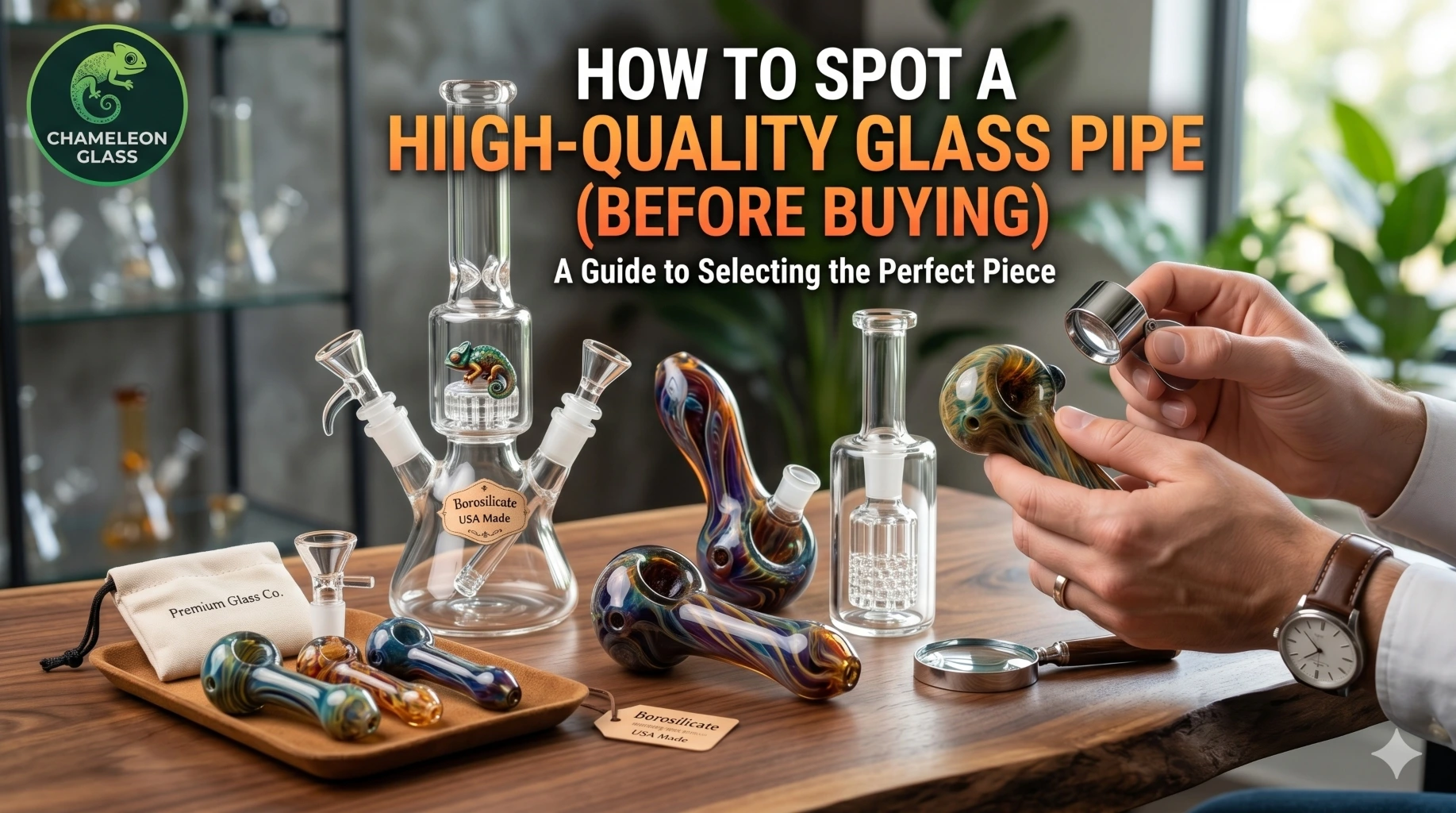
How to Spot a High-Quality Glass Pipe Before Buying
Most people buy their first glass pipe based on looks. That’s understandable — glass pipes are visually striking objects, and it’s natural to reach for the one that catches your eye. But looks alone are one of the least reliable ways to judge pipe quality. Two pipes sitting side by side in a display case can look nearly identical and perform completely differently — one lasting years of daily use, the other cracking within weeks of purchase.
The difference almost always comes down to a handful of specific, measurable quality indicators that most buyers don’t know to look for. Material composition. Annealing. Bowl construction. Fuming quality. Country of manufacture. These aren’t abstract concepts — they’re practical checkpoints that tell you, before you ever light a bowl, whether what you’re holding is worth the price or destined to disappoint.
This guide walks through every quality indicator worth knowing, explains what to look for in person and when buying online, and shows you exactly how Chameleon Glass’s quality standards and Glass Education resources reflect each one.
- The Material: Borosilicate vs. Soda-Lime Glass
This is the single most important quality indicator, and it’s also the hardest to detect visually. Every quality glass pipe is made from borosilicate glass — an engineered crystal material that contains boron trioxide, giving it a low thermal expansion coefficient. In plain terms, it handles heat stress without cracking, holds up to repeated use over years, and doesn’t leach anything into your smoke.
The majority of cheap imported pipes are made from soda-lime silicate — the same basic glass used in bottles and food packaging. Soda-lime glass is significantly cheaper to produce, and you genuinely cannot tell the difference by looking at or holding a pipe. The distinction only becomes apparent when the pipe fails — which it will, faster and more dramatically than borosilicate.
Chameleon Glass documented this issue directly in their Pyrex Ain’t Pyrex Anymore blog post, which details a test performed on a competing brand’s bong: submerged in vegetable oil, true borosilicate virtually disappears because the two materials share the same refractive index. The competing piece did not disappear — confirming it was soda-lime, not borosilicate.
What to look for: Ask directly. Any reputable manufacturer should be able to confirm their pipes are made from borosilicate glass. If a seller can’t answer the question, or deflects with vague language like “quality glass” or “durable glass,” walk away. Every Chameleon Glass product description specifies borosilicate (also referred to as Pyrex) explicitly.
- Annealing: The Invisible Strength Test
Borosilicate material is necessary but not sufficient. How the glass is treated after it’s shaped determines whether it’s actually strong. That process is called annealing.
When a blown glass pipe is shaped at the torch and allowed to cool at room temperature, the uneven cooling creates invisible internal stress throughout the piece. Those stress points are structural fractures waiting to happen. A pipe with residual stress can crack from a minor impact, a temperature change, or simply degrade over time — and you’ll never know it’s happening until it’s too late.
Annealing is a kiln-based heat treatment process where the finished pipe is brought back up to a precise temperature, then cooled in carefully controlled stages that allow internal stresses to dissipate. As Chameleon Glass explains in The Story Behind Your Hand Pipes, their annealing process holds the glass at temperature plateaus of 1,050°F and 960°F for specific amounts of time, allowing the glass matrix to fully reform after the stress of blowing and shaping.
Imported manufacturers routinely skip this step. Annealing requires expensive kilns and significant electricity — costs that eat into the margins of low-price producers. The result is a pipe that looks identical to a properly annealed piece but is riddled with invisible stress lines. The only way to detect this without specialized equipment is a polariscope — which is exactly why Chameleon Glass uses one as part of their standard quality control inspection on every single piece before it ships.
What to look for: Ask whether the pipe has been kiln-annealed. A brand that does it will mention it prominently — it’s a selling point that matters. Any brand that uses vague phrases like “flame annealed” or “naturally cooled” is signaling they’ve skipped the kiln. The Dragon Head Glass Pipe product description, for instance, specifies a precise step-down anneal process from 1,050° to 950° to 650°F — that’s the level of specificity that signals a brand takes the process seriously.
- Bowl Construction: Three Checks Before You Buy
The bowl is the part of the pipe that takes the most direct heat stress during every session. Poor bowl construction is one of the most common failure points in cheap glass pipes — and unlike annealing, it’s something you can actually inspect before buying.
Chameleon Glass’s Glass Education page outlines three specific things to check in a bowl:
Bowl hole size: The hole at the base of the bowl needs to fall within a precise range — no smaller than 2mm and no larger than 3mm. Too small and airflow is restricted, producing a harsh, labored draw. Too large and pull-through occurs — you get debris, ash, and particulate in your mouth. Chameleon Glass uses a two-stage QC tool with 2mm and 3mm diameter gauges to verify every single bowl before a pipe ships. That’s a standard almost no importer applies.
Fire polishing: After the bowl is pushed into shape using a carbon tool, the glass is at a lower temperature than it was during blowing — and that temperature differential leaves residual stress in the bowl area. A quality manufacturer fire-polishes the bowl after pushing, reheating and remelting the glass to relieve that stress. Left unpolished, stress shows up as jagged lateral lines inside the bowl that will eventually crack with repeated thermal cycling. Concentric circles are a form of stress that doesn’t cause cracking, but jagged vertical lines are a warning sign.
Air bubbles: Hold the pipe up to a light source and examine the bowl area carefully. Any air pocket larger than half a millimeter is a structural weakness — as the glass heats and cools during use, trapped air expands and contracts faster and more forcefully than solid glass, creating a stress cycle that will eventually crack the bowl. Small surface bubbles are cosmetic; internal bubbles in the bowl wall are a quality defect.
- The Thickness Myth — Why Heavier Isn’t Always Better
There’s a persistent belief among glass pipe buyers that heavier, thicker glass equals a stronger pipe. This is partially true and mostly misleading.
Chameleon Glass’s Glass Education page addresses this directly using basic engineering physics: Force equals Mass multiplied by Acceleration. When a pipe is dropped, the force of impact is a product of the pipe’s mass and the constant of gravity. A very thick, heavy pipe has greater mass — which means greater impact force when dropped. Thicker pipes feel more substantial in the hand, but they are not necessarily more impact-resistant and can actually be more prone to breaking on impact than a well-annealed pipe of average thickness.
There is a marginal strength benefit at the lower end of the thickness range — a paper-thin pipe is genuinely more fragile. But the common assumption that maximum thickness equals maximum strength simply isn’t true. Annealing is what determines impact resistance. Material is what determines thermal resistance. Thickness is mostly an aesthetic factor.
What to actually look for is consistency of wall thickness. A pipe where the walls are uniform throughout has been blown with skill. Pipes with uneven walls — thicker in some areas, thin in others — have stress concentration points at the transitions, which is where cracks originate.
- Color Work and Fuming Quality: What Real Color Change Looks Like
Color-changing glass is one of the most popular features in the pipe market and one of the most frequently misrepresented. Understanding what genuine fuming looks like versus a cheap imitation is a useful quality filter across the entire market.
Genuine color change is produced by fuming — vaporizing a thin, transparent layer of precious metal (silver, gold, platinum, or copper) onto the glass surface. That atomic-thin layer interacts with light passing through the glass, and as resin builds up inside the pipe with use, the reflected light shifts in color. Done correctly, a silver-fumed pipe develops blues, greens, and purples. Gold produces purples and pinks. Platinum shifts toward deeper blues.
The key word is transparent. The fume layer has to be thin enough that light passes through it. Cheap imitations apply silver so heavily and opaquely that no light passes through at all — the result is a pipe that shifts from orange-yellow to brown and never develops the rich color spectrum a properly fumed piece produces.
As Chameleon Glass documents on their Glass Education page, their color-changing pipes use interlacing layers of silver, gold, platinum, and copper applied with precision for maximum color development. The Spyrogyra Dichro Glass Pipe is a good example of this done at a high level — multi-layered silver and gold fuming applied inside-out, producing a deep, evolving color shift.
What to look for: On a clear, unfumed color-change pipe, the glass before first use should look slightly golden or warm-toned, not dull or grey. Pipes that look muddy or have an orange-brown tint before any resin has built up are over-fumed — they will not develop meaningful color change.
- Inside-Out vs. Surface Technique: Decoration Quality
There are two primary techniques for decorating a glass pipe: surface work and inside-out (ISO) work.
Surface technique applies color, patterns, and decorative elements to the outside of the glass tube. It’s the faster, more common method — used by virtually all imported glass and many domestic producers. Done well, it looks attractive. The limitation is that surface-applied decoration sits on top of the glass, is more susceptible to scratching and chemical damage during cleaning, and lacks the depth of inside-out work.
Inside-out technique (also called double-blown) works the decoration onto the interior surface of the glass tube before the pipe is closed and blown to final shape. All decoration is fully encased within the glass wall itself — it cannot be scratched, chemically stripped, or physically damaged. It also produces a three-dimensional visual depth that surface work cannot replicate. The Neutrino Dichro Sherlock is a clear demonstration — dichroic glass strips and silver fuming worked into the inside of the borosilicate tube, with color and depth that appear to float within the glass rather than sit on its surface.
Inside-out is more labor-intensive and requires significantly more skill than surface work. If a brand offers double-blown pieces, it’s a reliable signal that their artisans have the technical capability to produce genuinely high-quality glass.
- Country of Manufacture and Quality Guarantee
Where a pipe is made matters — not for reasons of nationalism, but for practical quality-control reasons. American-made glass pipe manufacturers are subject to domestic business standards, are reachable if problems arise, and have a reputation in the domestic market to protect. Overseas mass manufacturers operate at volume with minimal per-unit quality control and no meaningful accountability to the end buyer.
Beyond country of origin, look for a satisfaction guarantee. A brand that guarantees its product is a brand that has enough confidence in its quality to put money behind it. Chameleon Glass’s 100% satisfaction money-back guarantee isn’t just a marketing claim — it reflects the reality that a piece built from borosilicate, properly annealed, QC’d under a polariscope, and fire-polished at the bowl can be stood behind without financial risk.
Browse the full Glass Pipes collection — every product description specifies materials, dimensions, and manufacturing process in the kind of detail that only a brand with nothing to hide would publish. That transparency is itself a quality indicator.
The Quick Checklist Before You Buy
Before purchasing any glass pipe — in store or online — run through these questions:
Is it confirmed borosilicate glass, not generic “quality glass”? Has it been kiln-annealed, not just flame-annealed? Is the bowl fire-polished and free of internal air bubbles? Is the color work inside-out or surface-applied? If color-changing, does the fuming appear transparent rather than opaque? Is the manufacturer able and willing to stand behind the product with a guarantee? Is the country of manufacture confirmed?
Every Chameleon Glass pipe answers yes to all of the above. For a deeper understanding of what separates genuine quality from imitation, the full Glass Education page and Pyrex Ain’t Pyrex Anymore are the most comprehensive resources available anywhere on the subject.

Leave a Reply
You must be logged in to post a comment.