
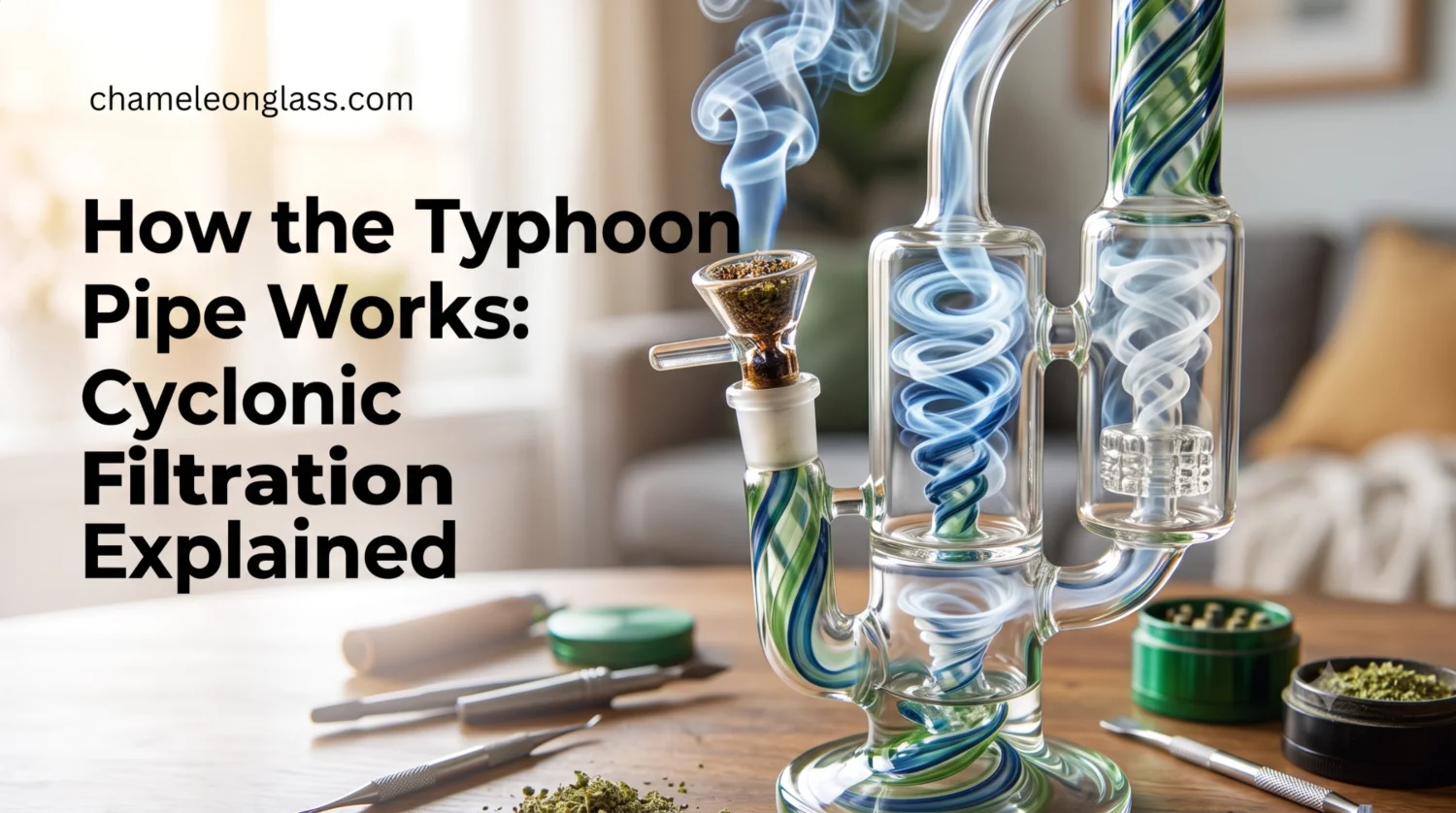
How the Typhoon Pipe Works: Cyclonic Filtration Explained
Most smokers know two ways to filter tobacco smoke: dry and wet. A dry hand pipe is the simplest — no filtration, just combustion and inhalation. A water pipe filters through liquid, cooling the smoke and trapping some particulate before it reaches your lungs.
The Typhoon is neither. It’s a dry pipe that behaves like a water pipe — filtering smoke through physics rather than liquid. No water to manage, no spill risk, no downstem to break. Just clean, cool, filtered smoke from a compact hand pipe you can carry anywhere.
Here’s how it works, why it works, and what makes the Typhoon one of the most innovative pipe designs Chameleon Glass has ever produced.
The Science: Bernoulli’s Equation and Cyclonic Airflow
The Typhoon’s filtration system is built around a principle called Bernoulli’s Equation — the same fluid dynamics that explains how aircraft wings generate lift and how a spray bottle moves liquid upward. At its core: when a fluid (including air) moves through a restricted path, its velocity increases and its pressure decreases. Nature responds to that pressure drop by pulling surrounding material into the flow.
Applied to the Typhoon: as you draw air through the pipe, it passes through specially engineered air directors on each side of the pipe’s chamber. These directors force the smoke and air mixture into a spinning, vortex path rather than a straight line. As the mixture spins inside the hemispherical chamber, centrifugal force acts on the particles in the smoke — and because combusted ash, tar, and particulate are denser than air, centrifugal force pushes them outward against the glass walls of the chamber.
The solid material sticks to the walls. The cleaner, lighter air continues through the vortex and into your lungs. You get a filtered, cooled hit — from a dry pipe with no water involved.
As Chameleon Glass explains on the Typhoon collection page: the smoke and air mixture travels three times further in the Typhoon’s circular path compared to a straight-bore pipe. That extended travel path means more time for the smoke to cool before it reaches your mouth — which is why Typhoon users consistently describe hits as noticeably smoother and cooler than a conventional dry pipe, even without any water filtration.
The Shape: Why a Sphere?
The hemispherical chamber design of the Typhoon isn’t aesthetic — it’s functional. A sphere is the optimal geometric shape for containing and directing airflow with minimal turbulence. Turbulence in a smoke path is what produces harsh, irregular hits; smooth, contained airflow produces consistent, predictable draws.
The original Typhoon design was inspired by hemispherical air filtration from automotive performance engineering — specifically spherical airflow patterns used in high-performance engine intake systems. The same principle that helped Hemi engines breathe more efficiently turned out to apply equally well to pipe engineering.
The Typhoon Collection
Every Typhoon pipe in the Chameleon Glass lineup is handmade in the USA from borosilicate glass, kiln-annealed at 1,050°F for impact resistance, and designed to deliver the same cyclonic filtration in different form factors and aesthetics:
Typhoon Classic Centrifugal Filter Glass Pipe — The original Typhoon design. Clean, functional, and built to demonstrate exactly how the cyclonic filtration system works. The clear glass lets you watch the smoke vortex in action. The go-to starting point for anyone new to the Typhoon concept.
Bonehead Typhoon Glass Pipe — The Typhoon Classic with Chameleon’s signature Bonehead skull face on the front, including a nose carb. Functional cyclonic filtration with a personality. As the product description puts it: “a daily reminder of our own mortality so that we may live the lives we are blessed to lead to the fullest.” Popular for both daily use and collecting.
Typhoon Cyclonic Pre Filter — The Typhoon filtration system translated into a standalone attachment for your water pipe. Connects inline and applies cyclonic pre-filtration before smoke ever reaches your bong’s water chamber. The result is a significantly cleaner draw and dramatically less residue buildup inside your bong. If you own a quality water pipe and want to extend the time between cleans while improving hit quality, this is the most practical upgrade available.
For the full range, browse the Typhoon collection.
Typhoon vs. Dry Pipe vs. Water Pipe: Where It Sits
A standard dry pipe (spoon, chillum, Sherlock) delivers unfiltered smoke directly. Whatever combustion produces goes straight to your mouth. A water pipe filters through liquid — effective but bulky, requiring water management and creating spillage risk.
The Typhoon sits between the two. Compared to a dry pipe, it delivers noticeably cooler and cleaner hits through centrifugal filtration — no opinion, it’s physics. Compared to a water pipe, it’s fully portable, spill-proof, and requires no water or downstem. It won’t outperform a well-designed multi-perc bong on pure filtration depth, but for a hand pipe you carry and use anywhere, nothing touches it.
For daily smokers who want meaningfully cleaner hits without the bulk of a water pipe, the Typhoon is the practical answer. Combine it with the Typhoon Cyclonic Pre Filter on your existing bong and you get cyclonic pre-filtration before water filtration — stacked layers of protection for the cleanest possible smoke.
Cleaning the Typhoon
The cyclonic design means tar and ash deposit in predictable locations inside the chamber walls. The Kleen Soaker is the recommended cleaner — non-toxic, alcohol-free, and effective at dissolving resin from glass surfaces without agitation. Soak, rinse, and the chamber walls come clean. For full cleaning guidance, visit the Glass Education page.
How Long Should a Glass Pipe Last?
It’s a question most people never think to ask before buying their first glass pipe — and one that becomes obvious the moment it breaks. How long should a glass pipe actually last?
The honest answer is: it depends entirely on what the pipe is made from, how it was manufactured, how you use it, and how you store and clean it. A quality American-made borosilicate glass pipe, treated with reasonable care, can last for years or even decades. A cheap imported piece might not survive its first month of daily use. The range between those two outcomes is wide enough that the question deserves a thorough answer.
Here is everything that determines how long your glass pipe lasts — the material science, the manufacturing factors, the daily habits that extend or shorten lifespan, and the practical steps you can take to protect whatever you own.
The Baseline: What Pipe Quality Does to Lifespan
Before anything else, the most important factor in how long a glass pipe lasts is what it’s made from and how it was built. No amount of careful handling can compensate for a structurally weak pipe — and no amount of rough handling will quickly destroy a pipe built to last.
Material: Borosilicate vs. soda-lime glass
Quality glass pipes are made from borosilicate glass — the same material used in laboratory equipment, high-end cookware, and medical instruments. Borosilicate has a low thermal expansion coefficient, meaning it doesn’t expand and contract dramatically under the heat cycling of regular use. It handles repeated exposure to flame and cooling without developing the micro-fractures that eventually cause a pipe to fail. A borosilicate pipe used daily for years will still be structurally sound if the underlying material hasn’t been compromised by impact.
Cheap imported pipes are typically made from soda-lime silicate glass — cheaper to produce, visually indistinguishable from borosilicate, and significantly less resistant to the thermal stress of daily use. Repeated heat cycling causes micro-fractures to develop inside the bowl and neck. You won’t see them forming. The pipe will perform normally right up until it doesn’t — cracking suddenly, often at the bowl where heat concentration is highest.
All Chameleon Glass hand pipes are built on borosilicate — specified clearly in every product description and confirmed in their Glass Education page. Every pipe from the compact Smokestack Glass Onie to the sculptural Dragon Head Glass Pipe uses genuine borosilicate constructed for long-term use.
Annealing: The process that actually makes glass strong
Borosilicate is necessary but not sufficient. The manufacturing process that determines whether a pipe will actually survive long-term use is annealing — a controlled kiln heat treatment that eliminates residual internal stress from the blowing and shaping process.
When glass is worked at the torch and then allowed to cool unevenly at room temperature, the differential cooling creates invisible internal stress points throughout the piece. Those stress points are structural weaknesses that will crack under impact, temperature change, or simply cumulative use over time. Annealing reverses this by returning the finished pipe to a precise temperature and then cooling it in controlled stages — allowing the glass’s molecular structure to fully reform without internal tension.
As documented across multiple Chameleon Glass product pages — from the Dichro Deviant Glass Pipe to the Neutrino Dichro Sherlock — every piece is oven-annealed at 1,050°F to ensure impact resistance and long life. Several water pipes in the range, including the Cambio Series Glass Water Pipe, the My RX Glass Water Pipe, and the Translucent Series Glass Water Pipe, go through a double annealing process — once after production and again after labelling — for maximum structural integrity.
Cheap imported pipes skip annealing almost universally because the process requires expensive kilns and electricity that erode the margins of low-cost production. The polariscope inspection Chameleon Glass performs on every pipe before shipping — confirming annealing has fully eliminated residual stress — is a process that no importer at bargain price points performs.
A properly annealed borosilicate pipe will last years with reasonable care. An unannealed one is a countdown to breakage from the moment you first light it.
How Daily Habits Affect Lifespan
Once you have a quality pipe, what you do with it every day determines how long it actually lasts.
Heat cycling and warm-up
Every time you light a bowl, the glass in the bowl area goes from ambient temperature to several hundred degrees in a matter of seconds, then cools back down when the session ends. Over time, even borosilicate experiences some degree of cumulative thermal stress — particularly in the bowl, where heat concentration is most intense.
The practical implication is simple: don’t subject your bowl to extreme temperature changes when you can avoid it. Don’t place a hot pipe directly on a cold stone or metal surface immediately after use. Don’t run cold water over a bowl that was just lit. Let the glass cool naturally between sessions and you’re eliminating a class of stress that accumulates over time.
Setting the pipe down
One of the most common ways a glass pipe breaks is the simplest: it gets set down, rolls, falls off the edge of a table, and hits the floor. This is particularly true of spoon-style pipes without a flat spot, Sherlocks, and any curved pipe that doesn’t sit stably on a flat surface.
Several Chameleon Glass designs address this directly. The Waterfall Sherlock Glass Pipe features a laid-back flat spot that keeps the bowl upright and prevents ash spills between sessions. The Ash Catcher Lawnchair Sherlock Glass Pipe has built-in legs that allow it to stand stably in two different orientations. The Waterfall Standup Sherlock Glass Pipe is specifically designed to stand upright on its own. These aren’t purely aesthetic features — they remove the most common cause of accidental breakage from your daily routine entirely.
Careless passing
Pipes used in group sessions see more handling, more drops, and more exposure to people who don’t know the piece as well as its owner. The best option for a pipe that gets passed around regularly is one with a compact, grippy design that’s less likely to slip out of a hand. The Waterfall Spoon Glass Pipe — built on 19mm diameter with 3mm wall thickness — is a compact, grippy pipe that handles regular use reliably. The Waterfall Chillum Glass Pipe is even more compact and harder to drop. For an annealed borosilicate pipe designed for everyday portability, the Symbiotic Chillum Glass Pipe is a strong choice — light, well-balanced, and handmade in the USA.
How Cleaning (or Not Cleaning) Affects Lifespan
Neglected cleaning doesn’t just affect flavor — it actively degrades the structure of your pipe over time.
Resin buildup inside the bowl and neck is not inert. It concentrates combustion byproducts that, when re-exposed to heat in subsequent sessions, produce additional chemical stress on the glass surface. Heavy, long-term buildup can become almost impossible to remove without aggressive solvents — and aggressive solvent exposure has its own risks, particularly on fumed color-changing pieces.
Regular cleaning keeps your pipe in better physical condition. For hand pipes, a warm water rinse every few sessions and a proper soak with the Kleen Soaker every one to two weeks keeps buildup from ever becoming a problem. Kleen Soaker is non-toxic, alcohol-free, abrasive-free, and safe on all types of glass including internally fumed color-change pieces. For a full cleaning setup, the Chameleon Glass Cleaning Kit includes the Buddy Scrubber with replaceable pads, a Cleaning Plug, and KLEEN solution — everything needed for proper maintenance of both hand pipes and water pipes.
For water pipes specifically, the most important cleaning habit is the simplest: empty and rinse after every session. Old bong water is the primary driver of rapid resin buildup, staining, and odor absorption in the glass. The Cleaning Plug for Glass Water Pipe makes soaking bongs and bubblers straightforward — seal the joint, add solution, soak, and rinse.
Storage: Where Most Pipes Die Unnecessarily
The majority of glass pipe breakage that isn’t caused by drops during active use happens during storage and transport. A pipe sitting in a bag with keys, a lighter, and a phone is a pipe waiting to get cracked. A pipe stored loosely on a shelf where it can be knocked off is a pipe with a ticking clock.
Proper storage is the single easiest way to extend the life of your glass, and Chameleon Glass carries a full range of storage solutions for every pipe type:
The Pillow Pouch is a padded, zippered pouch available in small and medium sizes — the small suits chillums and very compact pipes, while the medium fits any piece up to and including the Absolute Zero. It’s padded protection for storage at home and transit on the go.
The Shellz Pouch has a pill-capsule shape with foam egg crate padding on the inside top and bottom — a snug, protective case that looks good and absorbs impact from any angle. Chameleon Glass includes these with hand pipe, chillum, and bowl orders over $25.
For water pipes and larger pieces, the Large Pipe Pouch is 18 inches tall and designed specifically for medium-to-large water pipes and dry glass pieces. Available in blue or black, it includes interior and exterior pockets for accessories and a drawstring top with a side zipper for easy loading and removal.
For on-the-go storage with odor control, the RYOT Pack Ratz Pouch Small and RYOT Pack Ratz Pouch Medium combine SmellSafe activated carbon odor-blocking technology with antimicrobial microfiber padding — a discreet, practical case for smokers who carry their pipe outside the house. Browse the full Pouches, Cases and Protection category for all storage options.
What Shortens a Glass Pipe’s Life: A Quick Summary
Cheap soda-lime glass that can’t handle thermal cycling. Unannealed construction with invisible stress fractures waiting to release. Drilled bowl holes that impart mechanical stress at the most heat-exposed point of the pipe. No storage protection leading to accidental impacts. Neglected cleaning that allows buildup to degrade the interior surface. And exposure to extreme, rapid temperature changes — cold water on a hot bowl, placing a freshly lit pipe on a stone surface.
Remove as many of these variables as possible and a quality pipe will last indefinitely.
What Maximises a Glass Pipe’s Life
Buy borosilicate, not generic glass. Confirm it’s been kiln-annealed. Choose a design with a stable resting position — a flat spot, built-in legs, or a standup shape. Clean regularly with a safe solution. Store in a padded pouch when not in use. Avoid thermal shock. And buy from a manufacturer who checks every piece under a polariscope before it ships.
The Vandal Glass Pipe has been in continuous production because it’s built to last. The Bear Glass Pipe description promises a long-lasting lifespan because the material and process behind it genuinely deliver one. The Sea Turtle Sculpture Glass Pipe guarantees its aquatic companion “will remain by your side for years to come” — and that’s not marketing copy. It’s what borosilicate, proper annealing, and polariscope QC actually produce.
Browse the full Glass Pipes collection, read The Story Behind Your Hand Pipes, and visit the Glass Education page for the complete picture of what a pipe built to last actually looks like. Then protect it with the right storage and cleaning products and it will reward you for years.

Leave a Reply
You must be logged in to post a comment.