
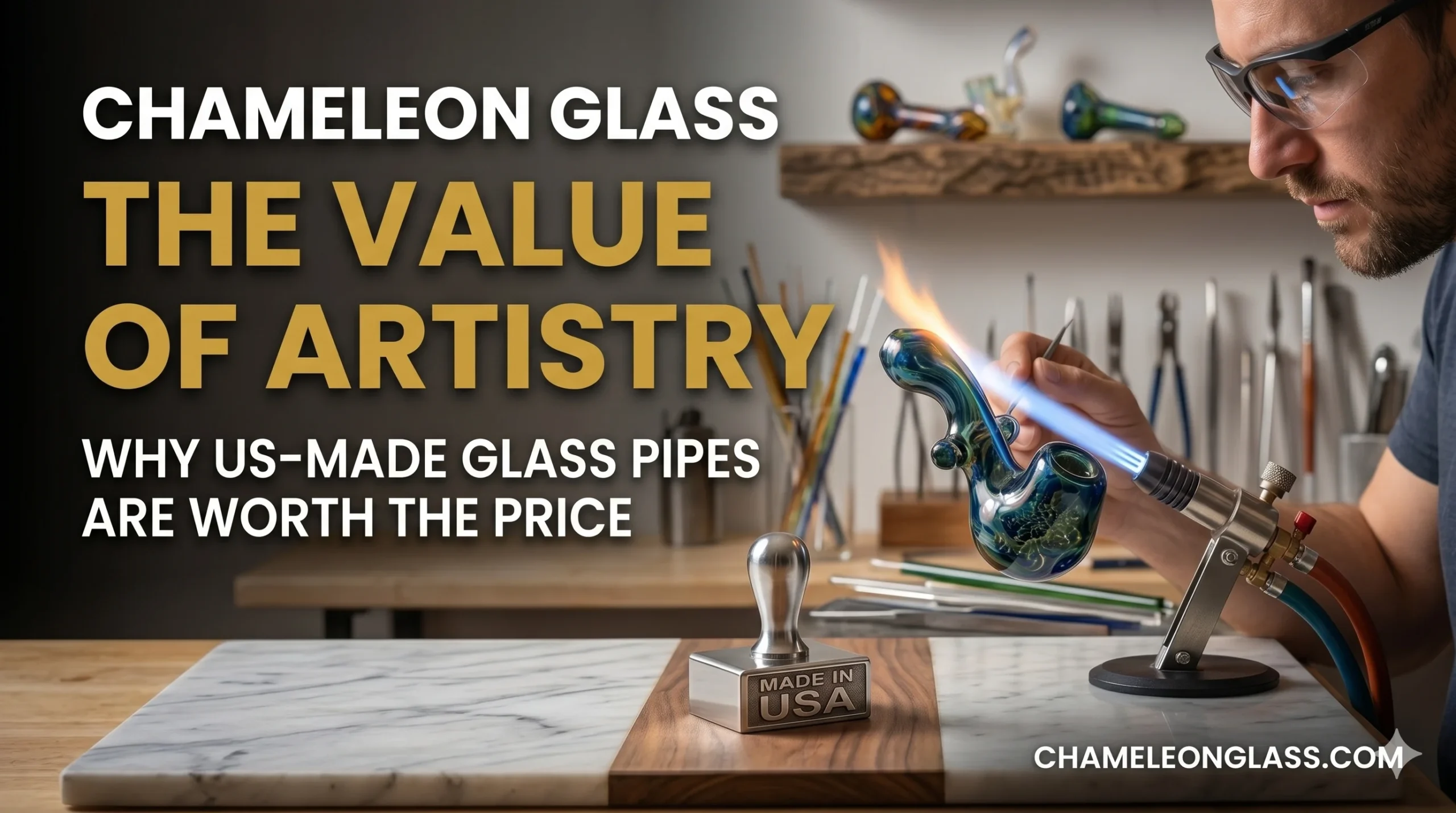
Why US-Made Glass Pipes Are Worth the Price
There’s a version of this conversation that happens in every smoke shop, at every price point: someone picks up a beautiful glass pipe, sees the tag, and asks why it costs more than the one next to it. The answer is almost always the same — one is made in America, and one isn’t.
That difference isn’t marketing. It’s not patriotism dressed up as quality. It’s a genuine, measurable gap in materials, technique, durability, and safety — and once you understand what separates an American-made glass pipe from a cheap import, you stop asking why the good one costs more. You start asking why anyone would settle for less.
Here’s everything you need to know about what goes into a genuinely quality-made glass pipe, why it matters, and what you lose when you buy based on price alone.
—
The Material Foundation: Borosilicate vs. Soda-Lime Glass
Everything starts with the raw material. Quality glass pipes are made from borosilicate glass — the same type of glass used in laboratory equipment, premium cookware, and medical instruments. Borosilicate has a low thermal expansion coefficient, meaning it resists cracking under the heat stress of repeated use. It’s dense, durable, and chemically inert, which means it doesn’t leach anything into your smoke.
The vast majority of cheap imported glass pipes are not made from borosilicate. They’re made from soda-lime silicate — the same basic glass used in bottles and packaging — with a tempering step added to make it look harder. Soda-lime glass is significantly cheaper to produce, and you genuinely cannot tell the difference by looking at it.
Chameleon Glass documented this issue in detail by purchasing a competing brand’s bong and performing a simple test: true borosilicate glass, when submerged in vegetable oil, virtually disappears because the two materials share the same refractive index. The imported piece did not disappear — confirming it was soda-lime, not borosilicate. The material substitution problem is widespread in the imported glass market.
The takeaway: with an American-made pipe, you know what you’re getting. With an import, you often don’t — and you won’t find out until it breaks.
—
The Process That Makes Glass Strong: Annealing
Making glass involves extreme heat. When a blown glass pipe is shaped and then left to cool at room temperature, the rapid, uneven cooling creates invisible internal stress throughout the glass. Those stress points are structural weaknesses — fractures waiting to happen. A pipe with residual stress can crack from a temperature change, a minor impact, or even just over time.
The solution is annealing — a controlled heat treatment process where the finished pipe is placed in a kiln and brought back up to a specific temperature, then cooled very slowly and precisely to allow the internal stresses to dissipate. Every single Chameleon Glass pipe is annealed in a kiln at 1,050°F using a step-down process from 1,050 to 950 to 650°F. The result is glass that is measurably stronger and more resistant to breaking than unannealed pieces.
Chinese manufacturers routinely skip annealing. It’s expensive, time-consuming, and — crucially — invisible to the buyer. You cannot see whether a pipe has been annealed. The only way to check is with a polariscope, a device that reveals residual stress patterns in glass under polarized light. Chameleon Glass uses a polariscope as part of their standard quality control process on every single pipe before it ships. When competing imports are inspected under a polariscope, they are routinely found to be riddled with residual stress.
This is the hidden cost of cheap glass. You’re not just paying for a piece that looks like it works. You’re paying for one that has been scientifically verified to be structurally sound.
—
The Double-Blown Technique: What Real Craftsmanship Looks Like
Most glass pipes are made using the surface technique — color and decoration are applied to the outside of a glass tube and worked into the surface. It’s efficient, produces a decent-looking result, and is what the majority of imported pipes use.
Chameleon Glass primarily uses the inside-out (ISO) technique, also called double-blown. Here, the decorative work is performed on the inside surface of the raw glass tube. The tube is essentially inverted — pre-melted into a wine glass shape — to give the artisan access to the interior, where color, fuming, and dichroic elements are applied and then fully melted into the glass wall. The tube is then closed and blown back out into its final shape.
The result is a level of depth, dimensionality, and visual crispness that surface work simply cannot replicate. Because the decoration is fully encased inside the glass rather than sitting on its surface, it cannot be scratched, worn, or chemically degraded. That’s not a technique you can replicate at scale in an overseas factory.
Standout Double-Blown Pieces from the Collection:
- The Neutrino Dichro Sherlock — Three strips of Green Grass Dichroic glass backed with Cobalt Blue, all worked on the inside of borosilicate tubing with silver fuming baked in, and annealed at 1,050°F.
- Xanadu Glass Pipe — Silver and gold fumed glass stringers worked inside out. Color changes with every session, revealing blues, greens, purples, and pinks over time. Handmade in the USA.
- Spyrogyra Dichro Glass Pipe — Dichro strips backed in cobalt blue, applied inside-out with layered silver and gold fuming for a multi-level color change. The marbles on the bowl add both visual depth and a functional finger grip.
- Oxford Glass Pipe — Full-piece gold and silver fuming with expansive color work spanning mouthpiece to bowl. The color transformation from clean to fully used is genuinely stunning on this one.
Shop Inside-Out & Double-Blown Pipes
—
The Science Behind Color-Changing Glass
Color-changing pipes are one of the most misunderstood products in the glass market. Cheap knock-offs attempt to replicate the effect by spraying silver so thickly and opaquely onto the glass surface that it becomes a crust rather than a fume — the result is a pipe that shifts from orange to brown and never develops the blues, greens, and purples a real fumed pipe produces.
Genuine color-changing glass relies on fuming — the process of vaporizing a precious metal (silver, gold, platinum, or copper) onto the glass at a precise thickness. That thin, transparent atomic layer is what interacts with light as it passes through the glass. When resin begins to build up inside the pipe from use, it causes the reflected light to pass through the fume layer differently, producing the appearance of color change. Different metals produce different color spectrums: silver shifts toward blues and greens; gold toward purples and pinks; platinum toward deeper blues.
Proper fuming requires a transparent layer applied with precision. Too thin and there’s no color change. Too thick and the pipe becomes opaque, blocking the light that creates the effect entirely. Getting it right requires skill developed over years, not a spray can and a price sheet.
For a straightforward entry into color-changing glass, the Ash Catcher with Pattern Glass Pipe is a great starting point — silver fuming that develops from blues to greens to purples over time, combined with the original ash catcher mouthpiece design.
To understand more about the physics behind this process, check out the Chameleon Glass Education Page.
—
Innovation Belongs to the People Who Do the Work
There’s another dimension to buying American-made that gets less attention but matters just as much: you’re supporting the people who actually invented these designs. Chameleon Glass has been creating original glass pipe designs since 1991. Every one of these designs has been copied by overseas manufacturers and sold at a fraction of the original price — without the quality of materials, the annealing, the double-blown technique, or the quality control. When you buy the cheap version, you’re not just getting an inferior product. You’re funding the people who stole the idea.
Some of the Enduring In-House Original Designs:
- Monsoon Spill-Proof Bubbler — The original portable water-filtration pipe. Spill-proof by design, 5 inches long, introduced an entirely new product category, and still the best version on the market after 20 years.
- Ash Catcher Glass Pipe — The original 2002 design with a deep, precisely-tooled cone mouthpiece. The knock-off “dimple” versions are shallower, less effective, and structurally inferior.
- Gandalf Glass Pipe — A long-stem pipe with a built-in flat spot for stability. Hand-crafted, kiln-annealed, and designed to last for years of daily use.
Learn more about the brand’s history of innovation on the Why Chameleon Page.
—
Quality Control: What Happens Before It Ships to You
Chameleon Glass performs quality checks on every single pipe before it ships. Not on a sample batch — on every piece. This includes visual inspection under light to detect surface cracks, polariscope inspection to confirm stress elimination, functional testing to verify proper draw, and aesthetic consistency checks.
If a piece doesn’t pass, it doesn’t ship. This is not how imported glass is handled. Overseas manufacturers operating at volume have no incentive to inspect individual pieces — defective glass is a cost of doing business that lands on the customer.
For example, pieces like the Dragon Head Glass Pipe have bowl holes quality-checked with a tool that measures precisely between 1.5mm and 2.5mm for consistent draw resistance, and annealing is completed with a precise, documented step-down process. That’s not guesswork — it’s accountability.
—
The Satisfaction Guarantee No Import Can Match
There’s a reason Chameleon Glass offers a 100% satisfaction money-back guarantee — because they can. When you’ve built your pipe from the right materials, through the right process, with the right quality control, standing behind it isn’t a risk. It’s a natural extension of actually caring about what you make.
Cheap imports rarely come with any meaningful warranty or return policy, because the margins don’t support it and the product doesn’t earn it. A pipe that costs pennies to produce has no room for a satisfaction guarantee.
—
What You’re Actually Paying for When You Buy American
- Material: True borosilicate glass vs. soda-lime silicate that can’t be distinguished visually until it breaks.
- Strength: Kiln-annealed at 1,050°F with polariscope verification vs. unannealed glass with invisible internal stress fractures.
- Technique: Inside-out, double-blown construction with fully encased decoration vs. surface-applied color that sits on the outside of the glass and degrades over time.
- Fuming: Precisely layered silver, gold, platinum, and copper fume applied transparently for genuine color change vs. opaque spray that turns brown.
- Quality Control: Every pipe inspected individually before shipping vs. batch manufacturing with no individual QC.
- Innovation: Original designs created, refined, and patented in the USA vs. knock-offs of those same designs produced overseas at a lower quality.
- Accountability: A 100% satisfaction guarantee backed by a team you can actually contact vs. a transaction with no recourse.
The price difference between a Chameleon Glass pipe and a cheap import isn’t a mystery. It’s a bill of materials. And when you see it laid out like this, the question stops being whether the American-made pipe is worth the price — and starts being whether the cheap one was ever worth buying at all.

Leave a Reply
You must be logged in to post a comment.